The Enduring Allure of the Emilio Pucci Dress: From Capri to the Global Stage

Few garments capture the spirit of post-war glamour quite like an Emilio Pucci dress. With its swirling geometric prints, vibrant Mediterranean colours and fluid silhouettes, the Emilio Pucci dress became a symbol of liberation, travel and effortless sophistication. Decades after the designer’s death, these distinctive pieces continue to captivate collectors, fashion enthusiasts and new generations discovering the joy of bold pattern. The story behind the Emilio Pucci dress is inseparable from the remarkable life of the man who created it.
Early Life and Background
Emilio Pucci, full name Marchese Emilio Pucci di Barsento, was born on 20 November 1914 in Naples. He belonged to one of Florence’s oldest aristocratic families, whose roots stretched back centuries. The family seat, the Palazzo Pucci in Florence, would later serve as both home and headquarters for his fashion house. His father, Orazio, came from the Florentine nobility, while his mother, Augusta Pavoncelli, brought Neapolitan connections.
Pucci grew up amid privilege yet developed a restless, adventurous spirit. A talented sportsman, he excelled at skiing, swimming, fencing and tennis. At seventeen he travelled to Lake Placid, New York, as part of the Italian team for the 1932 Winter Olympics, though he did not compete. After early studies in Italy, including time at the University of Milan, he headed to the United States. He studied agriculture at the University of Georgia before winning a scholarship to Reed College in Oregon, where he organised the college ski team and earned a Master of Arts in social science in 1937. He later completed a doctorate in political science at the University of Florence in 1941.
His early interest in practical, functional clothing emerged during his student years in America, when he designed improved ski outfits for the Reed team. These experiments with stretch fabrics and streamlined cuts foreshadowed the freedom of movement that would define the Emilio Pucci dress.
Career and Rise to Fame
Pucci’s path into fashion was unexpected. During the Second World War he served as a torpedo bomber pilot in the Italian Air Force, rising to captain and receiving decorations for valour. After the war, while skiing in Zermatt, Switzerland, in 1947, he designed a sleek ski outfit for a female friend. Photographer Toni Frissell captured the look for Harper’s Bazaar. The images caught the eye of editor Diana Vreeland, launching Pucci’s career.
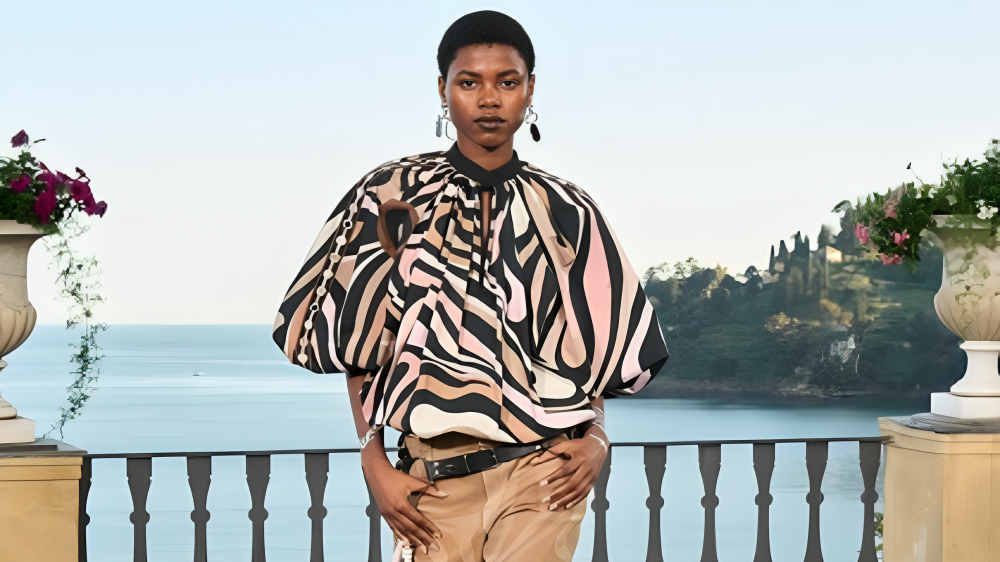
He opened a boutique on Capri in the late 1940s, first focusing on swimwear and resort clothes suited to the island’s glamorous set. By 1950 he had expanded into ready-to-wear. His breakthrough came with brightly coloured, boldly patterned silk jersey dresses and the now-iconic Capri pants. These pieces rejected the stiff formality of earlier couture in favour of soft, body-conscious shapes that moved with the wearer.
The 1950s and 1960s brought international acclaim. Pucci received the Neiman Marcus Fashion Award in 1954 and further recognition from Sports Illustrated and Harper’s Bazaar. His prints, inspired by Sicilian mosaics, the Siena Palio, Balinese batiks and Mediterranean light, featured kaleidoscopic geometrics in acid yellows, turquoise, pink and lime. Celebrities including Marilyn Monroe, Jacqueline Kennedy, Elizabeth Taylor and Sophia Loren embraced the Emilio Pucci dress. Monroe was famously interred in one after her death in 1962.
Pucci collaborated widely, designing uniforms for Braniff Airways that brought his prints into the jet age, and even creating an emblem for NASA’s Apollo 15 mission. He expanded into accessories, ceramics, perfume and men’s wear, while remaining rooted in Florence. His public reputation was that of a cultured aristocrat who brought joy and colour to fashion at a time of social change.
Personal Challenges or Turning Points
War left its mark. Pucci’s wartime service included high-risk missions and a later involvement in helping Edda Ciano, daughter of Mussolini, escape to Switzerland after her husband’s fall from favour. Accounts describe periods of imprisonment and hardship, after which he rebuilt his life through design.
The transition from military officer and aristocrat to working designer required courage. He once noted that he was the first member of his family to work in a thousand years. Business pressures mounted as demand exploded, yet he maintained high standards of craftsmanship in Italian textile mills, developing innovative stretch silks such as Emilioform.
Personal growth came through balancing public life with family. His political career in the Italian Parliament from 1963 to 1972 and service on the Florence city council reflected a broader engagement with civic duty. Through setbacks and shifting fashion trends, Pucci’s resilience showed in the consistent evolution of his aesthetic rather than radical reinvention.
Personal Life
In February 1959 Pucci married Cristina Nannini, a young woman from Rome whom he described as resembling a Botticelli. The couple had two children: Alessandro, born in 1959, and Laudomia, born in 1961. They made their home in the Palazzo Pucci, preserving family traditions while adapting the historic space to the needs of a modern fashion house.
Alessandro died in a car accident in 1998. Laudomia later took a leading role in the company, becoming image director and steward of the archive. Public statements from the family emphasise continuity and respect for Emilio’s original vision. Beyond these confirmed details, Pucci maintained a relatively private personal sphere despite his high-profile career.
Later Career and Current Activities
In his later years Pucci continued designing while overseeing the expansion of the brand. After his death from a heart attack in Florence on 29 November 1992 at the age of 78, Laudomia guided the house. In 2000 the French luxury group LVMH acquired a majority stake, later taking full ownership. Successive creative directors, including Christian Lacroix, Matthew Williamson and Peter Dundas, reinterpreted the prints for new eras. Since 2021 Camille Miceli has served as artistic director, emphasising the joyful, resort-rooted spirit of the original Emilio Pucci dress.
The brand remains active with runway collections, boutique presence and a strong archival focus. The Emilio Pucci Heritage Museum in Florence preserves drawings, garments and textiles. Contemporary interest has surged again, with the swirling prints appearing on social media and in summer wardrobes, proving the enduring appeal of the Emilio Pucci dress.
Quick Bio
| Detail | Information |
| Full Name | Marchese Emilio Pucci di Barsento |
| Date of Birth | 20 November 1914 |
| Place of Birth | Naples, Italy |
| Nationality | Italian |
| Profession | Fashion designer, politician |
| Years Active | 1947–1992 |
| Known For | Colourful geometric prints, silk jersey dresses, Capri pants |
| Estimated Net Worth | Not publicly confirmed with reliable figures |
Legacy and Lasting Impact
The Emilio Pucci dress helped redefine post-war fashion by prioritising colour, pattern and ease of movement. Pucci contributed to the rise of Italian ready-to-wear and the global image of “Made in Italy.” His prints influenced subsequent generations of designers and remain instantly recognisable. Public perception holds him as a sophisticated innovator who mixed aristocratic heritage with democratic accessibility through vibrant design.
His life offers a lesson in turning chance observation into lasting creation, and in remaining true to a personal vision amid changing tastes. The continued success of the house under family and corporate stewardship ensures that new audiences encounter the same sense of optimism that defined the original Emilio Pucci dress.
Conclusion
From the ski slopes of Switzerland to the boutiques of Capri and the wardrobes of international icons, the journey of the Emilio Pucci dress mirrors the restless creativity of its founder. Emilio Pucci transformed functional sportswear into high fashion and left behind a visual language of joyful geometry that still feels modern. Whether worn as a vintage find or a contemporary reinterpretation, an Emilio Pucci dress carries a distinctive energy that transcends trends.
Must Read: UFC 326: Holloway vs Oliveira 2 – Rematch, Ratings and a New BMF in Las Vegas